

| Types of Stainless Steel Profiles and Their Structural Applications |
| Release Date: 2026-05-22 Views: 34 times |
|
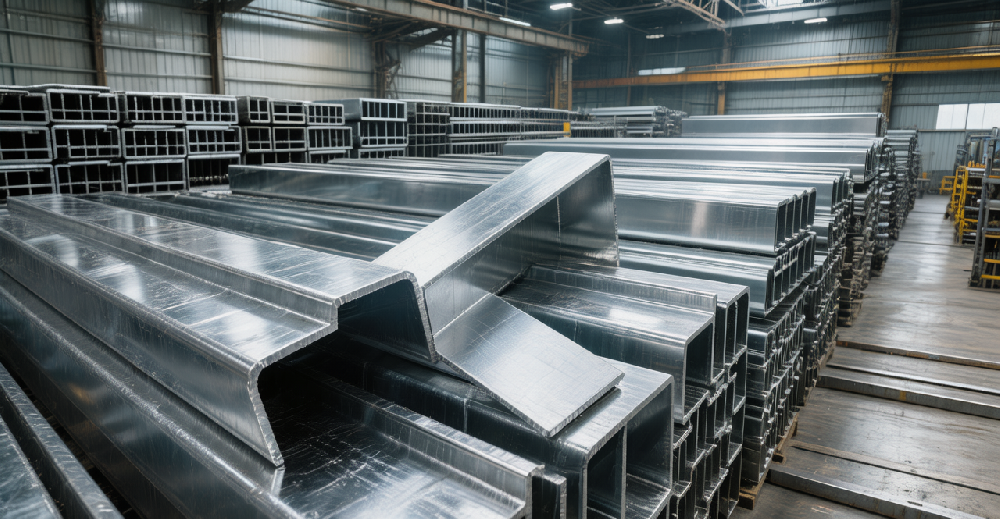
Stainless steel profiles are important basic components in building structures and industrial manufacturing, with rich cross-sectional shapes and specifications meeting diverse engineering demands. 1. Common Types of Stainless Steel Profiles Stainless steel profiles mainly include: angle steel, with an L-shaped cross-section, widely used in brackets, frames, and connectors; channel steel, with a C-shaped cross-section providing higher bending stiffness, suitable for load-bearing structures; I-beams, whose excellent bending resistance makes them important load-bearing members in building structures; flat bars and square bars, commonly used in guardrail grilles and decorative components; round bars, serving as basic materials for tension rods, pins, and mechanical parts. Additionally, various non-standard custom profiles provide solutions for special design requirements. 2. Production Processes and Quality Standards Production processes for stainless steel profiles include hot rolling, cold drawing, and welded forming. Hot-rolled profiles have rougher surfaces but lower costs, suitable for non-exposed structures; cold-drawn profiles offer high dimensional precision and smooth surfaces, suitable for exposed decoration and precision machinery. National standards provide clear specifications for dimensional tolerances, curvature, and torsion of different profiles. 3. Structural Application Scenarios In building engineering, stainless steel profiles are commonly used for curtain wall mullions, canopy supports, staircase structures, guardrail systems, and glass handrail connectors. The combined advantages of high strength and corrosion resistance are particularly prominent in special environments such as coastal buildings and swimming complexes. In the industrial sector, stainless steel profiles are ideal choices for non-standard equipment frames, conveyor lines, and operating platforms. 4. Key Design Points for Profile Selection During selection, appropriate cross-sections and specifications should be chosen based on load calculations, while also considering the rationality of connection joint design and construction feasibility. In corrosive environments, the material grade should be appropriately upgraded, and safety margins should be reserved during design. |